

One pane for everything behind your firewalls.
Manage and monitor applications and systems behind firewalls. A small client, devops-client, runs next to each system and connects outward through a message bus, so the system needs no inbound port or VPN. People use it through a web UI, machines through an API, and AI agents through MCP.
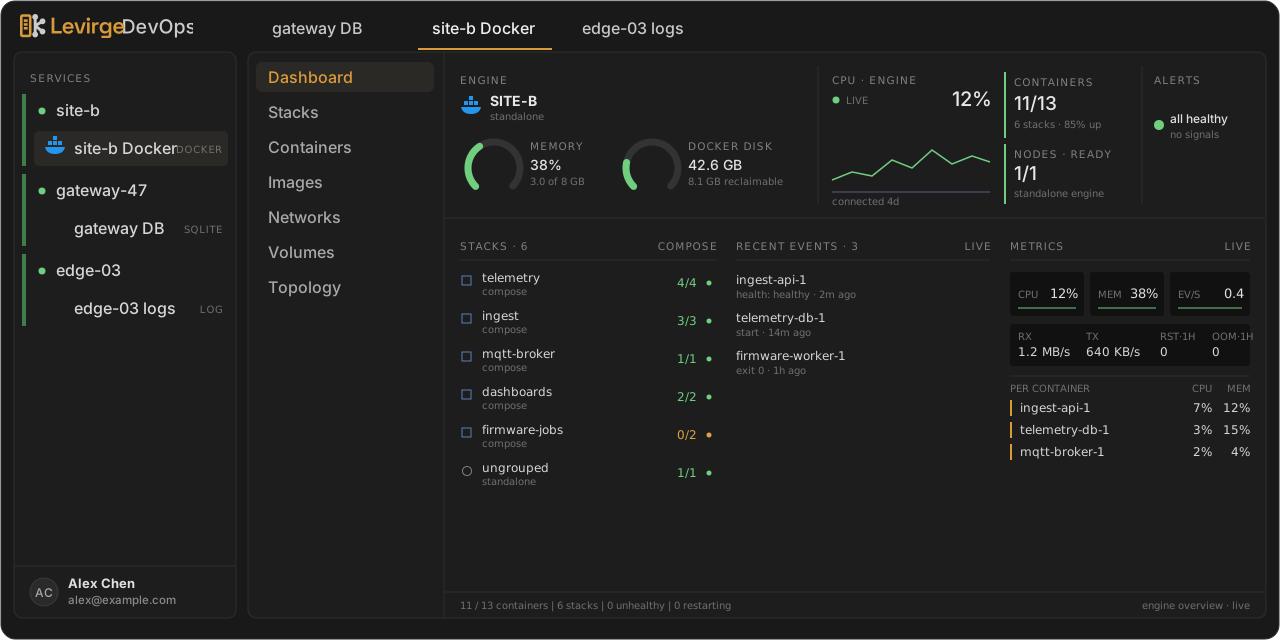
Illustrative mock-up of the Docker dashboard with made-up data, not a screenshot.
Databases, logs, Docker and message buses
In the web UI, services are grouped in the sidebar, and you can pin the ones you use most and switch between All and Pinned.
SQLite
DatabaseConnection, queries, saved queries, query history and audit log.
PostgreSQL
DatabaseQueries, schema browsing, resizable result columns and export.
MySQL / MariaDB
DatabaseQueries, schema browsing, resizable result columns and export.
Redis / Valkey
DatabaseDashboard, console, key browser and value editing.
MongoDB
DatabaseFind, aggregate and schema browsing.
InfluxDB 2.x
DatabaseFlux queries with a results table and export.
Log files
LogsLive tail, search and read log files and whole log directories.
Files
FilesRead-only file browser, confined to the folders you choose.
Docker
ContainersRead-only dashboard, gauges and containers view, with host CPU and memory.
MQTT
Message busBrowse and subscribe to topics, and see broker stats.
NATS
Message busServer, stream, consumer and key-value monitoring, with message rates.
llama.cpp
Model serverLoaded model, live token rates and slot use.
Host metrics
SystemCPU, memory, load, network, disks, GPUs and top processes.
TP-Link Omada
NetworkSites, gateways, switches, access points, clients and alerts from an Omada controller.
Let agents monitor and investigate, faster
An incident spans systems: a slow query, an error in the logs, a container out of memory. Over MCP, an agent checks each of them in one session and comes back with the evidence, instead of you opening a VPN and five consoles.
One session across every system
An agent reads databases, logs, containers, model servers and the message bus through one MCP connection, wherever devops-client runs.
Finds the right connection
find_connection turns a name like “checkout” into the connection to use, and suggests close matches when there's no exact one.
Ready-made investigations
Built-in prompts start an agent on a service investigation, a query plan, slow queries in the logs, a container health check or Redis memory.
Errors that say what to do next
A failed call returns a code and, where there is one, the next tool to call, so the agent recovers without guessing.
Read-only unless you say otherwise
Agent tokens read what they're granted. Writes need a writer role, checked at Levirge DevOps and again at devops-client.
Every agent action on record
The audit log marks what an agent did apart from what a person did.
| Step | The agent calls | What it learns |
|---|---|---|
| 1 | find_connection"checkout" | The checkout database, its log directory and the Docker host |
| 2 | log_searchpattern: "timeout" | Timeouts started at 09:40, all on one endpoint |
| 3 | docker_get_statscheckout-api | CPU and memory are normal, so it isn't the container |
| 4 | run_queryEXPLAIN ANALYZE … | A sequential scan on orders since an index was dropped |
Illustrative investigation with made-up names and results. Each plugin page lists its MCP tools. How agents monitor your infrastructure →
Reach the system without opening it up
No inbound port or VPN
devops-client connects outward through a message bus, so the system behind the firewall needs no inbound port or VPN.
Credentials stay on the host
Passwords, connection strings, hosts and file paths aren't sent over the message bus.
Writes need a role
At devops-client, a caller with no role is read-only, and a connection can also be set read-only. These are two separate checks. Database writes in the web UI also ask for an authenticator code.
Actions are audited
Each request is recorded in an audit log.
For people and machines
People use the web UI, scripts use the API, and AI agents use MCP.
One small binary
A single binary of about 42 MB, statically linked for Linux. Windows isn't a target. There is no public download yet.
One place to reach every environment
devops-client runs next to the systems in each environment and connects outward, so nothing behind the firewall needs an inbound port or VPN. People, scripts and AI agents all come through Levirge DevOps.
Example layout with made-up environments. Monitoring remote and factory sites →
One pane, or a tool and a way in for each system
A tool per system
- An inbound port or VPN to reach each network
- A separate login and tool for databases, logs and containers
Levirge DevOps
- No inbound port or VPN: devops-client connects out
- Databases, logs, Docker and message buses in one place
Be first to put devops-client behind your firewall
devops-client has no public download yet. Join the waitlist and we'll email you when it does.
Check your inbox
Confirm the subscription from the email we just sent and you're on the list.